Welcome. This is a practice for adults who want a different relationship with pornography. Find a quiet place where you can safely give this recording your attention. Do not listen while driving. You can keep your eyes open, change position, or stop whenever you choose. There is no special state you need to enter, and no promise you need to make. Let one ordinary point of contact become clear. Your feet touch the floor. The chair supports your back. Your hands can rest. Allow the breath to move in its own way. You can leave a little room after the next breath out. The purpose of this practice is simple. You are rehearsing a pause between noticing a familiar urge and following it. A thought can be present while your hands do something else. Your attention can return to the room. Your next choice can belong to you. You do not need to force a feeling away for that to be possible. Let your body find a supported position. There is no need to sit in a particular way. You can keep your eyes open or allow them to close, as long as you are somewhere safe to rest your attention. Notice where the surface beneath you is already doing some of the work. Your feet, your back, or your hands can give you a simple place to begin.
Take a moment to notice the room without searching for anything special. There may be a light, a shadow, a small sound, or the temperature of the air on your skin. These details are not obstacles to the practice. They are ways to remain in contact with the place where you actually are. You can return to them whenever an imagined scene feels unhelpful.
Let your breathing continue naturally. You do not need to make it deeper, hold it, or get a rhythm exactly right. If a slightly slower breath out feels comfortable, you can allow it. If it does not, leave the breath alone and notice your feet instead. This is an invitation to settle, not a test of how relaxed you can become.
Notice the muscles around your eyes. Allow a little less effort there, if that is available. Notice your jaw and the place where your tongue rests. Your shoulders may settle a little, or they may stay as they are. You do not need to force a change. You can let the chair or the surface beneath you hold what it already holds.
Now notice your hands. They are useful hands. They can close a screen, make a meal, turn a page, touch a railing, or rest without doing anything. For this moment, there is no button they have to press. Notice one small sensation in a palm or a fingertip. You are bringing attention to something ordinary and real.
A thought may arrive while you do this. It could be about the day, the habit, or whether the recording is working. You can notice that a thought has arrived without turning it into the whole practice. Let the next ordinary point of contact become clear again. Your attention does not need to stay perfectly still for you to practice returning it.
Imagine, if you like, a little space around the thought. You do not have to remove it. You do not have to debate it. It can remain in the room of your experience while you notice the support beneath your body. If imagining is difficult or unwelcome, you can stay with a real object instead. The practice belongs to you in either form.
Bring to mind your reason for wanting a different relationship with pornography. Keep the reason broad and personal. Perhaps you want your evenings back, more sleep, or a different use of your attention. You do not need to prove that reason to anyone. You do not need to picture explicit material to remember why you are here.
Let that reason be a direction rather than a threat. A direction can guide the next small action without deciding your whole future. You can use this practice to rehearse one response, then return to the day with a little more room to choose. The next part offers an imagined scene. Use only the details that fit, and keep the room around you available.
A life with more room for your values is made of ordinary moments. It may include rest, hobbies, work, company, or adult relationships with consent and clear boundaries. This practice does not prescribe a perfect lifestyle or promise that every other activity will immediately feel more rewarding.
You can choose something because it matters, even when its reward is quieter than a screen. You can make space for desire without following the pornography route you want to leave. And you can practice presence without expecting another person to provide relief, intimacy, or forgiveness on demand.
Keep the image believable. A small shared moment, a completed task, or an earlier bedtime is enough material for a useful rehearsal. Your reasons can remain yours, and your next action can respect both your own boundaries and the choices of anyone else involved.
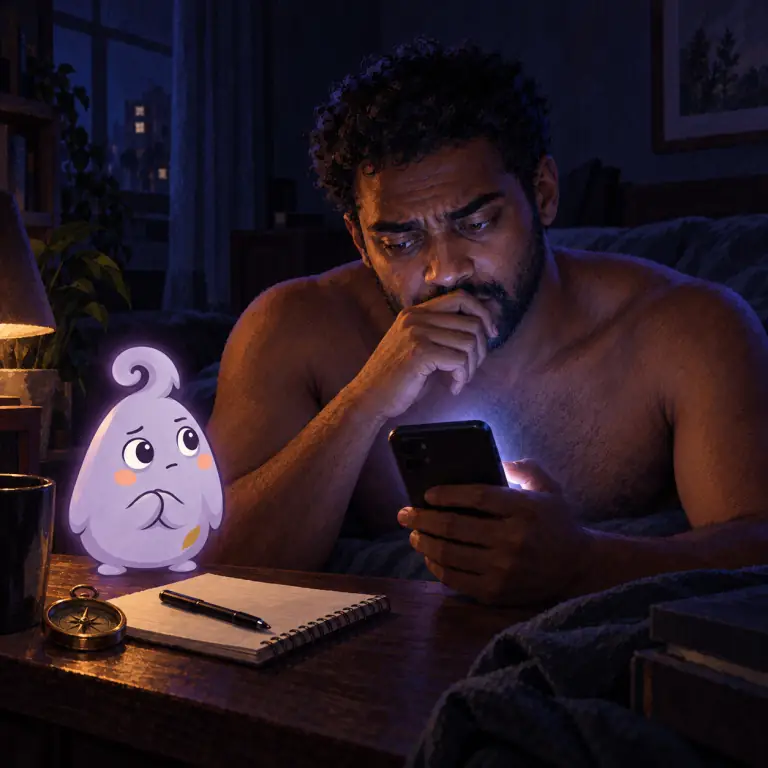
A decision can be quiet. Imagine a compass on an open map. It points toward a direction, not a guarantee that the road has no obstacles. Your reason for changing the pattern may be private and practical. You want more sleep, more presence, or a different use of your attention. You can return to that reason when a familiar cue appears. There is no audience to convince and no need to borrow someone else’s values. The compass belongs to you, and the next step can be modest enough to take today.
Bring the scene into view only as clearly as feels comfortable: a compass resting on an open map. You can imagine it lightly, think about it in words, or stay with an ordinary object in the room. There is no requirement to produce a vivid picture. The useful part is the response you are about to rehearse.
Let one neutral cue stand for the beginning of the familiar pattern. It might be the shape of a closed device, a general moment of reaching, or a thought written on a plain card. Keep it general. You do not need to inspect explicit content, summon an old scene, or check whether a real website still draws your attention.
For this part of the rehearsal, use this instruction: State your reason in one sentence without moralizing.
Take your time with it. Begin with the smallest version that makes sense in your actual life. Notice where your hands would be, where your feet would go, or what you would say in your own mind. You can leave the feeling in the background while the chosen response becomes a little clearer. Let the scene stay simple enough that the next action remains visible.
Now imagine trying that response in an ordinary moment, rather than an ideal one. Perhaps you are a little tired. Perhaps the first impulse is still there. You do not need to add a dramatic struggle. Notice that the response can be begun under these ordinary conditions. Allow a few breaths while you consider the first small movement.
Let the picture rest for a moment. Return to one real point of contact beneath your body. The rehearsal is an option you can use, not an obligation to create a particular feeling. If something does not fit, make it smaller or choose a practical alternative that serves the same purpose.
For this part of the rehearsal, use this instruction: Picture a familiar cue appearing while your direction remains available.
Take your time with it. Begin with the smallest version that makes sense in your actual life. Notice where your hands would be, where your feet would go, or what you would say in your own mind. You can leave the feeling in the background while the chosen response becomes a little clearer. Let the scene stay simple enough that the next action remains visible.
Now imagine trying that response in an ordinary moment, rather than an ideal one. Perhaps you are a little tired. Perhaps the first impulse is still there. You do not need to add a dramatic struggle. Notice that the response can be begun under these ordinary conditions. Allow a few breaths while you consider the first small movement.
Let the picture rest for a moment. Return to one real point of contact beneath your body. The rehearsal is an option you can use, not an obligation to create a particular feeling. If something does not fit, make it smaller or choose a practical alternative that serves the same purpose.
For this part of the rehearsal, use this instruction: Choose a small step that matches the reason rather than proves your strength.
Take your time with it. Begin with the smallest version that makes sense in your actual life. Notice where your hands would be, where your feet would go, or what you would say in your own mind. You can leave the feeling in the background while the chosen response becomes a little clearer. Let the scene stay simple enough that the next action remains visible.
Now imagine trying that response in an ordinary moment, rather than an ideal one. Perhaps you are a little tired. Perhaps the first impulse is still there. You do not need to add a dramatic struggle. Notice that the response can be begun under these ordinary conditions. Allow a few breaths while you consider the first small movement.
Let the picture rest for a moment. Return to one real point of contact beneath your body. The rehearsal is an option you can use, not an obligation to create a particular feeling. If something does not fit, make it smaller or choose a practical alternative that serves the same purpose.
Now connect the parts of the practice to one clear next action. Write your reason and take one action that expresses it.
Imagine the action beginning. Do not stop the scene at the moment of decision. Let your hand move, your feet take the first step, or the next activity open in front of you. Follow a few ordinary seconds after the choice. What is the next visible detail? A closed lid. Water in a glass. A page turning. The room around you, still available.
The urge may fade, change, or remain for a while. This rehearsal does not need to predict which. You are practicing a response that can be used while a feeling is present. Stay with the chosen action for a few ordinary moments, without checking whether it has produced enough relief. The action is allowed to matter because it fits your reason for changing the pattern.
Now let the scene begin again from the early cue. Use the same practical response once more, gently. There is no need to add detail to the cue itself. Give the next action more attention than the temptation. Let the scene move through the pause and into the beginning of the activity you chose.
Now look at the imagined moment from a little farther away. See the setting around the cue. Notice the time of day, the place where the device sits, and what happened before you reached it. You do not have to become an investigator of every detail. Choose one ordinary detail that seems useful for your plan.
Ask what made the familiar route easy in that moment. Perhaps the device was already open. Perhaps you had no next activity in mind. Perhaps you were tired and the usual boundary needed too many decisions. Let the answer be practical. You can change an arrangement without making a grand claim about your strength.
Now imagine one small change made before the cue appears. A charger is elsewhere. A task card is visible. An activity is prepared. A trusted person knows you would welcome a conversation. Keep the change within your control and within your actual circumstances. You do not need a perfect house, a perfect schedule, or a perfect mood.
Replay the beginning of the moment with that change in place. Notice what is easier to do now. Your hands have somewhere else to go. Your attention has a next step. The urge may still appear, and the change can still be useful. You are practicing support for a choice, rather than trying to prevent every uncomfortable feeling.
Consider a day when the first plan does not work as smoothly. Perhaps you are away from home, another person needs the room, or the activity you chose is unavailable. Let yourself choose a smaller backup. A glass of water, a short change of rooms, or writing down the next step may be enough to begin again. The backup should be ordinary enough to remember.
Now imagine explaining the plan to yourself in one short sentence. When I notice the early cue, I will take this next action. Say the sentence gently in your own mind. You do not need to add forever or never. You are naming a response you can practice in a specific situation.
Give the sentence a moment to settle. Notice how it differs from an argument. An argument can continue without an ending. A practical plan points toward something your hands or feet can actually do. Return to that action now. Let it be small, visible, and yours.
Picture one likely moment later today or tomorrow when this practice might be useful. Keep the setting broad and neutral. You might be in the room where you usually browse, at the end of a workday, or holding a device when a familiar thought appears. You do not need to bring up anything explicit to recognize the beginning.
Before the old route becomes a whole story, imagine a pause. Feel one real point of contact. Remember the scene of a compass resting on an open map. If that image is useful, let it be a brief cue for the response, not a picture you have to keep repeating. If it is not useful, let it go and use the practical action alone.
Here is the action again. Write your reason and take one action that expresses it. Imagine doing the first part of it. Then allow the next few seconds to continue. You are leaving room for real life to move forward after the choice. It can be imperfect, quiet, and ordinary.
Consider what might make the action easier to remember. You could move an object, write a short note, prepare an activity, or choose a place for the device before the moment arrives. Pick one support that you can control. Keep it modest enough that it does not become another task to avoid.
Now consider what you would do if the first choice did not go as planned. You can stop the loop at the next available moment. You can return to the room, meet a basic need, and revise the support. A difficult moment can provide information without deciding your worth or your whole future.
Let the future rehearsal end with the chosen activity underway. Your hands are doing something ordinary. Your attention has somewhere else to return. Keep that ending simple and believable. You are practicing a possible response, and your actual next choice will still be yours.
Let the imagined scene become less important. You do not need to keep holding it in front of you. Notice the surface beneath your body again. Notice the air and the ordinary sounds around you. Allow your breathing to continue in its own comfortable way.
Move your fingers or your feet if you like. Let your gaze become clearer, or open your eyes when you are ready. Take enough time to return to ordinary alertness before standing or beginning something that needs your full attention.
Keep one useful detail from this practice rather than trying to memorize every sentence. It might be the early cue, the image you chose, or the first practical action. If the imagery did not fit, you can keep the action alone. You are free to adapt the exercise.
The recording ends here. Your next ordinary choice begins where you actually are. There is no need to make a dramatic promise. Give yourself a moment, look around the room, and begin the small action you chose.